Close Menu
  • Latest News
    • Bitcoin
    • Ethereum
    • Altcoins
    • Meme Coins
  • Tech
    • Blockchain
    • Security and Privacy
  • Web 3
    • Gaming
  • Legal
    • Legal and Regulatory
    • Adoption
  • Analysis
  • Learn
    • Education
    • Wallets and Exchanges
  • Tools
    • Market Overview
    • Exchange Tool
What's Hot

Bitcoin Open Interest jumps 8% – Why BTC price faces liquidation risks

October 23, 2026

Stand With Crypto Advances GENIUS Act Implementation

October 23, 2026

Cosmos crypto defies market weakness – Can ATOM rally toward $2?

October 23, 2026
Facebook X (Twitter) Instagram
  • Contact
  • Privacy Policy
  • Terms & Conditions
  • Disclosure
Facebook X (Twitter) Instagram
Free.cc (Free Cryptocurrency)Free.cc (Free Cryptocurrency)
  • Latest News
    1. Bitcoin
    2. Ethereum
    3. Altcoins
    4. Meme Coins
    5. View All

    Bitcoin Open Interest jumps 8% – Why BTC price faces liquidation risks

    October 23, 2026

    Bitcoin, Hyperliquid (HYPE) and Zcash (ZEC) Price Ready to Bounce Back

    October 23, 2026

    Bitcoin, gold trim early losses as yen gives up gains. Oil stays near $100

    October 23, 2026

    The Sleeper Has Awakened: Pepenardo’s Sleeping Knights Return

    October 23, 2026

    ETH Slips Below $2,400 as ETF Outflows and Market Sell-Off Pressure Bulls

    October 22, 2026

    Ethereum: Can $61M in whale withdrawals help ETH bulls regain control?

    October 22, 2026

    Ethereum staking hits record highs – So why are yields falling?

    October 22, 2026

    Top Analysts Say A Rebound Could Be Close

    October 21, 2026

    Cosmos crypto defies market weakness – Can ATOM rally toward $2?

    October 23, 2026

    Chainlink’s $1.02M whale buy: An early Q4 signal or an isolated bet?

    October 23, 2026

    Zcash Foundation Details Zebra Sync Fixes Ahead Of NU7 Release

    October 23, 2026

    Perceptron announces ‘strategic migration’ of 800K node intelligence network to Walrus

    October 22, 2026

    Top 5 Memecoins to Watch in 2026: Hype, Utility, or Growth?

    October 14, 2026

    Did Jean Phil Go Viral First — or Was the Viral Persona Built to Launch a Memecoin?

    October 5, 2026

    Thinking Cat Gains Momentum After CASHCAT’s Breakout

    August 12, 2026

    What Tokens Could He Target?

    July 30, 2026

    Bitcoin Open Interest jumps 8% – Why BTC price faces liquidation risks

    October 23, 2026

    Stand With Crypto Advances GENIUS Act Implementation

    October 23, 2026

    Cosmos crypto defies market weakness – Can ATOM rally toward $2?

    October 23, 2026

    NeoRedPill launches Telegram wallet bot with Neo N3 wallets, cross-chain bridging

    October 23, 2026
  • Tech
    1. Blockchain
    2. Security and Privacy
    3. View All

    NeoRedPill launches Telegram wallet bot with Neo N3 wallets, cross-chain bridging

    October 23, 2026

    Quantum-Safe Blockchain Design Could Cut Fees and Network Bloat

    October 23, 2026

    User Empowerment in New Tweet

    October 23, 2026

    Prividium Delivers Control for Institutions as Money2020

    October 23, 2026

    Coinbase, Bitgo Say Unaffected by PHP Flaw; Binance’s CZ Urges Caution

    October 22, 2026

    Crypto Thieves Hijack Ngrave Alerts and Walk Away With $2.56M

    October 21, 2026

    Zcash Proposes New Privacy Layer to Guard Swaps From Quantum Risks

    October 20, 2026

    Qubic Loses $1.3 Million in Wallet Raid Before Network Halts

    October 18, 2026

    Bitcoin Open Interest jumps 8% – Why BTC price faces liquidation risks

    October 23, 2026

    Stand With Crypto Advances GENIUS Act Implementation

    October 23, 2026

    Cosmos crypto defies market weakness – Can ATOM rally toward $2?

    October 23, 2026

    NeoRedPill launches Telegram wallet bot with Neo N3 wallets, cross-chain bridging

    October 23, 2026
  • Web 3
    1. Gaming
    2. View All

    Top 12 NFT games every player should know about in August 2026

    September 22, 2026

    GameShame Studios founder details Raijin Protocol’s roadmap in NeoPod’s sixth AMA

    September 22, 2026

    Proof of Play to shut down after blockchain gaming thesis falls short

    September 22, 2026

    How BC.GAME is turning players into stakeholders

    September 22, 2026

    Bitcoin Open Interest jumps 8% – Why BTC price faces liquidation risks

    October 23, 2026

    Stand With Crypto Advances GENIUS Act Implementation

    October 23, 2026

    Cosmos crypto defies market weakness – Can ATOM rally toward $2?

    October 23, 2026

    NeoRedPill launches Telegram wallet bot with Neo N3 wallets, cross-chain bridging

    October 23, 2026
  • Legal
    1. Legal and Regulatory
    2. Adoption
    3. View All

    Stand With Crypto Advances GENIUS Act Implementation

    October 23, 2026

    Digital Chamber Celebrates GENIUS Act Finalization, A Win

    October 23, 2026

    UK FCA Opens DeFi and Crypto Consultations Ahead of 2027 Rules

    October 23, 2026

    UK financial watchdog opens consultations for DeFi guidance, crypto laws

    October 23, 2026

    Germany’s main savings bank network launches Bitcoin trading

    October 21, 2026

    Two firms control corporate Bitcoin buys, even as business adoption broadens

    October 16, 2026

    AI agents keep coming back for crypto as x402 wallet refill rate surges to 89%

    October 15, 2026

    Interactive Brokers moves into Ethereum’s $110 billion staking market as institutional demand accelerates

    October 14, 2026

    Bitcoin Open Interest jumps 8% – Why BTC price faces liquidation risks

    October 23, 2026

    Stand With Crypto Advances GENIUS Act Implementation

    October 23, 2026

    Cosmos crypto defies market weakness – Can ATOM rally toward $2?

    October 23, 2026

    NeoRedPill launches Telegram wallet bot with Neo N3 wallets, cross-chain bridging

    October 23, 2026
  • Analysis

    Evernorth XRP Holdings to Target Higher XRP Per Share, CEO Says

    October 23, 2026

    The Crucial $245 Level That Decides Bittensor’s Next Move

    October 23, 2026

    Can Fibre Push TIA Toward $9?

    October 22, 2026

    Does Avalanche Have What It Takes To Hit $55?

    October 22, 2026

    Solana bot turns just $12,000 into $1.4 billion in trading volume as fake liquidity floods Raydium

    October 22, 2026
  • Learn
    1. Education
    2. Wallets and Exchanges
    3. View All

    What Is Robinhood Chain? The Ethereum Layer-2 Network for Tokenized Stocks

    July 12, 2026

    What Is BChat? The Decentralized Messaging App Built for Privacy

    June 2, 2026

    What Is an AI Prompt Injection Attack? The Hidden Threat Hijacking Your Chatbots

    May 31, 2026

    What Is AI Jailbreaking? A Beginner’s Guide to the Cat-and-Mouse Game Behind Every Chatbot

    May 17, 2026

    SideSwap reopens Bitcoin swaps while Liquid reserves stay locked

    October 22, 2026

    Binance bStocks collateral pricing moves to 24/7

    October 21, 2026

    Binance Pool shuts on November 10, with record access ending two weeks later

    October 18, 2026

    82 criminal charges follow armed crypto abduction in Toronto

    October 16, 2026

    Bitcoin Open Interest jumps 8% – Why BTC price faces liquidation risks

    October 23, 2026

    Stand With Crypto Advances GENIUS Act Implementation

    October 23, 2026

    Cosmos crypto defies market weakness – Can ATOM rally toward $2?

    October 23, 2026

    NeoRedPill launches Telegram wallet bot with Neo N3 wallets, cross-chain bridging

    October 23, 2026
  • Tools
    • Market Overview
    • Exchange Tool
Free.cc (Free Cryptocurrency)Free.cc (Free Cryptocurrency)
Home»Legal and Regulatory»Washington has started selecting which crypto firms control custody at a national level
Washington has started selecting which crypto firms control custody at a national level
Legal and Regulatory

Washington has started selecting which crypto firms control custody at a national level

April 3, 2026No Comments7 Mins Read
Share
Facebook Twitter LinkedIn Pinterest Email

On Apr. 2, Coinbase received conditional approval from the Office of the Comptroller of the Currency for a national trust charter.

Coinbase joined a cluster of at least eight firms that the OCC has moved toward federal trust-charter status since December 2025, and the cluster reveals a deliberate federal decision about which parts of crypto belong inside the supervised system.

Why this matters: The US is shifting from regulating crypto to selecting which parts of the stack sit inside the banking perimeter. That decision defines who can scale nationally, who captures institutional flows, and who remains outside the system.

The OCC conditionally approved Circle, Ripple, BitGo, Fidelity, and Paxos on Dec. 12, 2025. Bridge followed in February, Crypto.com in February, and Coinbase in April.

Eight approvals in roughly four months, all clustered around custody, reserve management, stablecoin infrastructure, and settlement. That density reframes the Coinbase headline as a data point in a federal design decision.
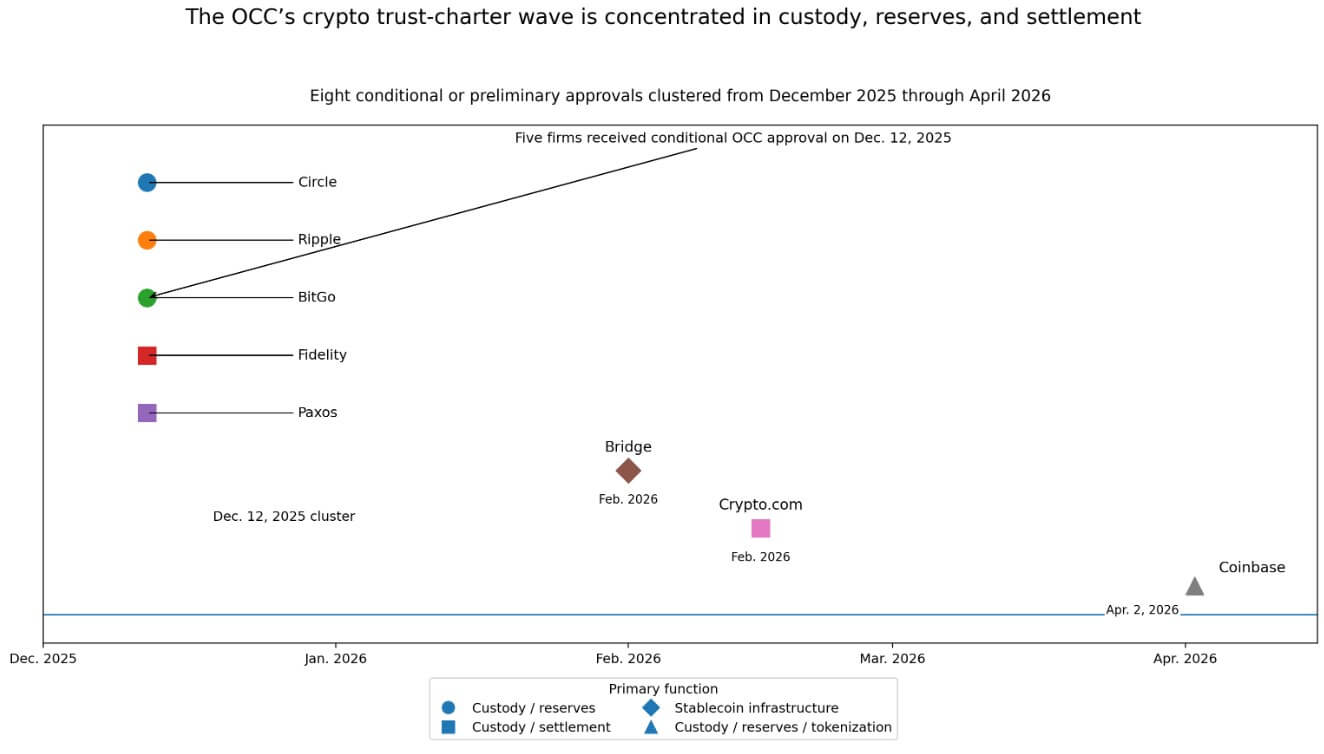
OCC's crypto trust charter wave
A scatter plot charts eight conditional OCC trust-charter approvals across three primary functions, custody, settlement, and stablecoin infrastructure, from December 2025 through April 2026.

A national trust charter gives firms federal reach under a single OCC supervisor, allowing them to operate across all 50 states without having to assemble a patchwork of state approvals.

National trust banks hold client assets and facilitate settlement under a fiduciary mandate, operating within a purpose-built custody-and-settlement structure. The lane’s practical value lies in scope and supervisory clarity: firms can hold client assets and handle settlement functions under a single federal framework.

Paxos explicitly framed its national trust push as a move beyond its New York state trust structure, and that framing reveals an architectural logic.

The functions Washington is comfortable supervising

The approvals cluster around custody, reserves, and settlement because that is where the OCC’s comfort level currently sits.

Reports noted that Crypto.com’s charter would cover client asset management and trade settlement, keeping the firm within custody and settlement functions. Bridge’s approval covered stablecoin issuance and orchestration, as well as reserve management.

The OCC’s Circle decision described digital-asset custody and reserve-management services tied to its fiduciary activities. Coinbase said full approval could support tokenized securities and stablecoins.

See also  A No-BS Legal Guide for Bitcoin and Crypto Builders

Washington is drawing a perimeter around the functions tokenized finance needs most, such as asset custody, stablecoin reserve backing, and settlement infrastructure, and extending supervisory authority over firms that provide them.

The firms best positioned in this environment are custodians, reserve managers, and stablecoin infrastructure operators.

Adjacent regulatory moves reinforce that reading. In March 2026, US bank regulators said tokenized securities would not face additional capital charges purely for being tokenized, calling the framework technology-neutral.

The SEC allowed intraday trading of tokenized shares of the WisdomTree money-market fund, approved Nasdaq’s tokenized trading proposal, and cleared NYSE’s tokenized securities partnership with Securitize.

The OCC charter wave and the tokenization rule stack are moving in tandem, with institutional infrastructure as the common thread.

VISUAL 2

The re-intermediation arc

Crypto’s original commercial promise was removing the regulated intermediaries that traditional finance required.

The practical outcome of the OCC cluster is re-intermediation: the most commercially durable crypto firms are now competing to become a new class of regulated intermediaries. Tokenized finance needs custodians, reserve managers, and settlement rails before it needs another trading venue with more listed assets.

Capital is already pricing that reality. Mastercard agreed to buy BVNK, a stablecoin infrastructure firm, for up to $1.8 billion. OpenFX raised $94 million and reported annualized payment volume climbing from $4 billion to $45 billion in a year, with over 98% of transactions settling in under 60 minutes.

The global stablecoin market stood at over $310 billion in February 2026. These are backend-plumbing bets, concentrated in custody, settlement, and reserve management.

The competitive map is also narrowing. Anchorage is currently the only digital asset company operating under a full national trust bank charter. The December cluster and subsequent approvals are conditional or preliminary.

Getting to the final operating status requires demonstrating capital adequacy, governance, and operational controls to OCC examiners. This bar will compress the field toward well-capitalized incumbents with existing compliance infrastructure.
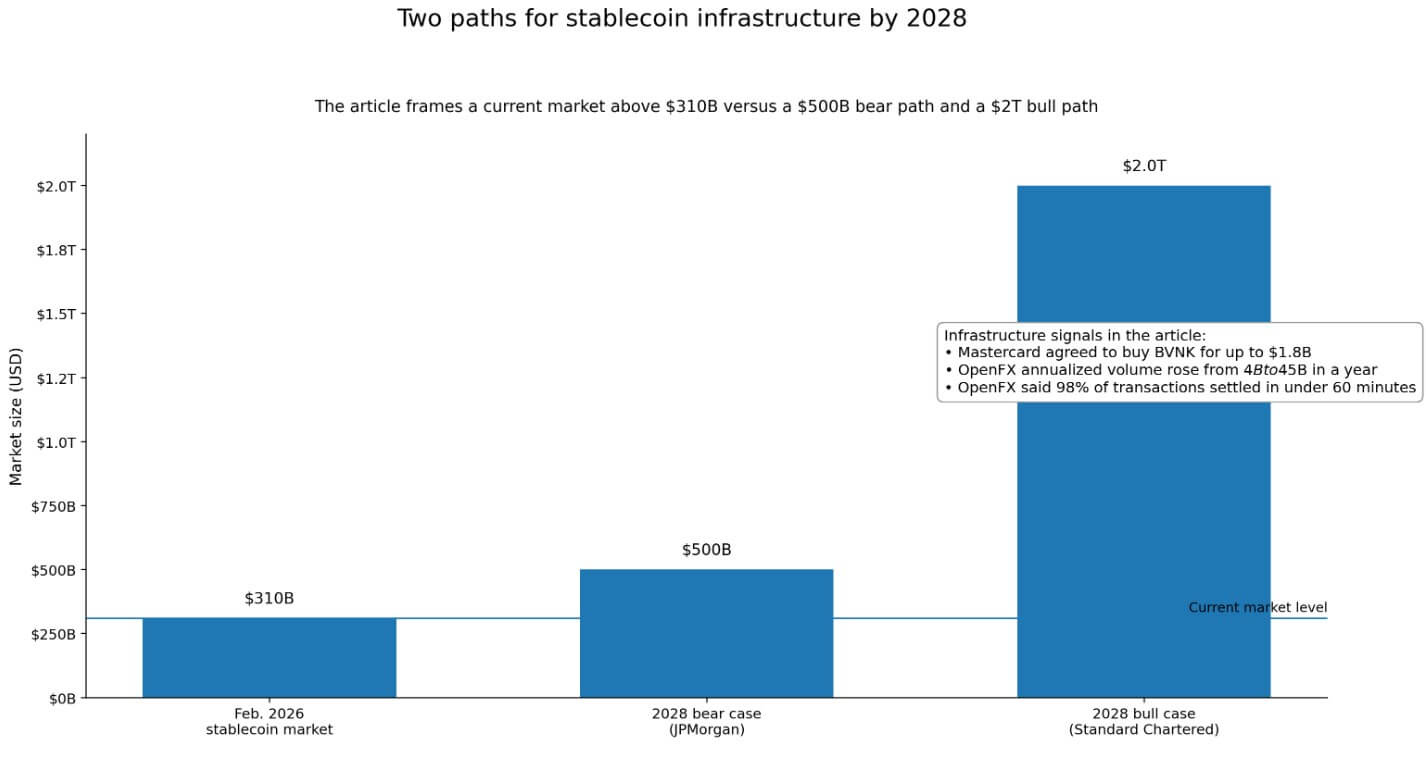
OCC crypto charters and the two paths for stablecoin infra by 2028
A bar chart contrasts the $310 billion February 2026 stablecoin market against JPMorgan’s $500 billion bear forecast and Standard Chartered’s $2 trillion bull forecast for 2028.

Two paths forward

In the bull case, the OCC finalizes its stablecoin implementation in terms that institutions can operationalize.

See also  Bitcoin Mining And Crypto Stocks Fall As Bitcoin Slumps More

Tokenized securities pilots on Nasdaq and NYSE move from proof-of-concept to live settlement infrastructure, while firms like Mastercard accelerate the adoption of stablecoin rails across global payment corridors.

If stablecoins approach Standard Chartered’s $2 trillion forecast by 2028 and tokenized real-world assets reach comparable scale, federally supervised crypto utilities become the scarce picks-and-shovels of digital finance.

The OCC’s chartered custodians and reserve managers collect margin on trillions of dollars in assets that flow through the infrastructure they control.

In the bear case, final approvals move slowly as bank trade groups press their “lighter-touch charter” objection, and the OCC responds by tightening conditions on reserve buffers, liquidity stress tests, and operational controls.

The stablecoin market tracks closer to JPMorgan’s $500 billion by 2028 forecast, a ceiling anchored by the fact that payments account for only about 6% of current stablecoin demand, roughly $15 billion of the $310 billion outstanding.

In that world, state trust structures and bank partnerships stay practical, and the federal lane becomes a premium niche.

The federal bet

Washington is sorting crypto’s functions into those it wants to supervise and those it does not, or at least not yet.

The charter cluster, the stablecoin reserve rules under the GENIUS Act, and the technology-neutral treatment of tokenized securities together form a regulated stack for crypto-native financial infrastructure.

The power the OCC is extending is real. Still, it carries supervisory costs: monthly public reserve disclosures for stablecoin issuers, weekly confidential reporting under the proposed implementation rule, and full OCC examination authority.

Comparison point OCC national trust charter State trust / state-licensed structure Bank-partnership model
Primary supervisor OCC State regulators Partner bank’s federal/state bank supervisor plus partner compliance requirements
Geographic reach National, under a single federal framework across all 50 states More limited; state-based and potentially patchwork Depends on partner bank structure rather than firm’s own charter
Core functions highlighted in article Custody, reserve management, stablecoin infrastructure, settlement, potential support for tokenized securities Similar functions can be done, but without the same single federal lane Practical way to access banking, payments, and settlement functions without own federal charter
Strategic value Supervisory clarity and national scale Flexibility, but less unified than federal lane Faster/practical access for firms that do not want or cannot obtain a charter
Supervisory burden High Lower than OCC lane, based on article’s contrast Shared/mediated through bank partner requirements
Stablecoin disclosure burden Monthly public reserve disclosures; weekly confidential reporting under proposed implementation rule Not described in article at the same level Not described in article at the same level
Examination authority Full OCC examination authority State examination authority Bank partner oversight and exam environment, not direct OCC trust-bank status for the crypto firm
Firms best positioned Well-capitalized incumbents with strong governance, capital adequacy, and operational controls Firms comfortable staying in state-licensed layer Firms using partnerships as a practical alternative to federal chartering
Competitive implication Could become scarce “picks-and-shovels” infrastructure if tokenized finance scales Remains viable if federal approvals stay slow or narrow Remains viable in bear/slower-adoption scenario
Main tradeoff National reach and legitimacy, but heavier compliance and supervisory costs Less supervisory intensity, but less federal uniformity Less direct control over infrastructure stack, but easier access route
Best fit in article’s framing Firms aiming to be federally supervised crypto utilities Firms that stay outside the federal lane Firms choosing a practical alternative while the federal lane remains selective
See also  Balchunas says tokenized stocks unlikely to disrupt ETFs as SEC gears up for rule change

The firms that clear that bar will operate nationally under a single federal supervisor, hold institutional assets, and process tokenized settlements in a framework that traditional finance counterparties can use.

Those who cannot or choose not to will stay in the state-licensed layer, and the charter wave is starting to sort itself out.

The post Washington has started selecting which crypto firms control custody at a national level appeared first on CryptoSlate.

Control Crypto custody Firms level national selecting Started Washington
Share. Facebook Twitter Pinterest LinkedIn Tumblr Email

Related Posts

Stand With Crypto Advances GENIUS Act Implementation

October 23, 2026

Cosmos crypto defies market weakness – Can ATOM rally toward $2?

October 23, 2026

Digital Chamber Celebrates GENIUS Act Finalization, A Win

October 23, 2026

UK FCA Opens DeFi and Crypto Consultations Ahead of 2027 Rules

October 23, 2026
Add A Comment
Leave A Reply Cancel Reply

Top Posts

‘Bitcoin Is Less Tech, More Money,’ Says GetBit CEO

September 11, 2025

Will UNI Crypto Hit $22 Before Year-End?

October 28, 2025

Stay ahead with the latest crypto news, market updates, blockchain insights, and trends. Your trusted source for everything happening in the digital asset world.


We're social. Connect with us:

Facebook X (Twitter) Instagram Pinterest YouTube
Top Insights

Bitcoin Open Interest jumps 8% – Why BTC price faces liquidation risks

October 23, 2026

Stand With Crypto Advances GENIUS Act Implementation

October 23, 2026

Cosmos crypto defies market weakness – Can ATOM rally toward $2?

October 23, 2026
Get Informed

Subscribe to Updates

Get the latest creative news From Free.cc directly in your Inbox!

  • Contact
  • Privacy Policy
  • Terms & Conditions
  • Disclosure
© 2026 free.cc - All rights reserved.

Type above and press Enter to search. Press Esc to cancel.